
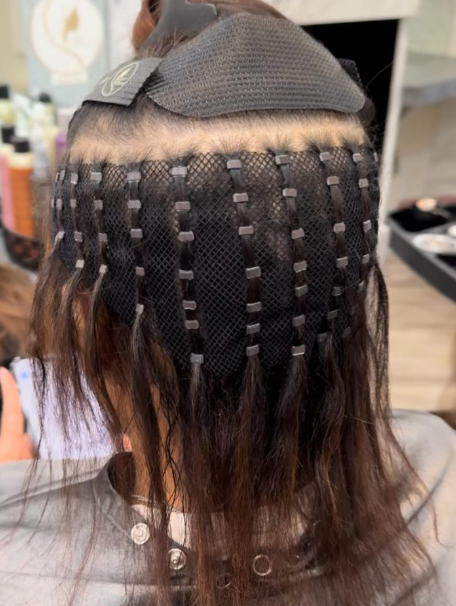
When Traditional Hair Extensions Aren’t Enough: Mesh Integration for Thinning Hair
Mesh integration for thinning hair offers an alternative when conventional extensions cannot provide the coverage or support your hair needs. Although traditional extensions can add beautiful length and volume, they aren’t designed to solve every type of hair thinning.
At Dreamhouse Salon in downtown Fayetteville, Arkansas, Greg helps women understand when traditional extensions may work and when a customized integration system deserves consideration.
Why Traditional Extensions Have Limitations
Conventional extensions rely on natural hair to support additional strands or wefts. Therefore, the strength and density of your existing hair determine which methods may be appropriate.
For example, someone with naturally fine but dense hair may comfortably support lightweight extensions. However, someone experiencing significant crown thinning may lack sufficient coverage to conceal the attachments.
Additionally, excessive weight or tension can contribute to breakage and traction-related hair loss.
Consequently, adding more extensions isn’t always the safest or most effective solution.
How Mesh Integration for Thinning Hair Works
Mesh integration uses a specialized foundation to support supplemental hair while incorporating suitable existing hair.
Unlike conventional extensions, the foundation can provide coverage across areas with reduced density. This allows the stylist to address certain thinning patterns that traditional wefts cannot adequately conceal.
First, the stylist evaluates the natural hair and scalp. Next, they determine whether the existing hair can safely support the proposed system.
Then, they plan the placement, coverage, and blending of the supplemental hair.
However, mesh integration still requires appropriate support and ongoing maintenance. It isn’t suitable for every hair loss condition.
When Should You Consider an Integration System?
Women experiencing visible scalp, widening parts, or reduced crown density may benefit from exploring integration.
Additionally, some clients notice that traditional extensions create fullness through the ends but leave the top looking thin.
For these women, adding length alone doesn’t address the primary concern.
Instead, integration may help create coverage where the hair appears sparse.
Nevertheless, active shedding, scalp inflammation, or fragile hair can affect suitability. Therefore, unexplained hair loss should receive medical evaluation before cosmetic attachment services.
Why Customization Matters More Than Hair Quantity
A successful integration plan considers much more than the amount of supplemental hair.
For instance, hair color, texture, movement, density, and attachment placement all influence the finished appearance.
Furthermore, the system should fit the client’s everyday styling routine and maintenance preferences.
At Dreamhouse Salon, Greg evaluates these factors during personalized thinning-hair consultations.
Clients from Fayetteville, Bentonville, Rogers, and Springdale can explore options without assuming that one technique works for everyone.
Explore Your Options at Dreamhouse Salon
If conventional extensions no longer address your concerns, mesh integration for thinning hair may offer another approach.
However, choosing an appropriate solution begins with understanding your existing hair and identifying realistic coverage goals.
At Dreamhouse Salon, Greg provides consultations for mesh integration, meshless integration, and women’s thinning-hair concerns.
Whether you’re experiencing early density changes or more noticeable thinning, you’ll receive guidance based on your individual needs.
Schedule a consultation with Greg at our downtown Fayetteville salon to discuss your options.
Leave a Reply